Wednesday, 13 September 2017

Important Missiles of India.

 Important Missiles of India. 

Recently, in IBPS/SBI PO & Clerk and other such banking exams, many questions were asked about Important Missiles of India. Therefore, go through the list of Indian Missiles, listed along with their range and type thoroughly.

Indian MissilesTypeRange
AstraAir to Air
Missiles

Radar homing
beyond-visual-range
air-to-air
missile
60 to
80 Km
K-100Air to Air
Missiles

Medium Range
300 to
400 Km
NagAnti Tank
Missile
4 Km
Helina
(Helicopter
Launched
Nag)
Anti Tank
Missile
7 to
8 Km
Ashwin
Ballistic Missile
Interceptor or
Advanced
Air
Defense
(AAD)
Anti-Tank
Missile
150+ Km
NirbhaySubsonic
Cruise
Missile
1,000  to
1,500 Km
BrahMosCruise
Missile

Fastest Cruise
Missile in the World
Supersonic
cruise
Missile
290 Km
BrahMos
II
Cruise
Missile

Hypersonic
cruise
Missile
300 Km
BrahMos
A
Cruise
Missile
BrahMos
M
Cruise
Missile
290 Km
BrahMos
NG
Cruise
Missile
290 Km
Prithvi Air
Defense
(PAD)
Defense
Missile

Exo-atmospheric
Anti-ballistic
missile
80 Km
Altitude
Advanced
Air
Defence
Defense
Missile

Endo-atmospheric
Anti-ballistic
missile
30 Km
Altitude
Prithvi
Defense
Vehicle
(PDV)
Defense
Missile

Exo –atmospheric
Anti-ballistic
missile
120
Altitude
AkashSurface to
Air Missile

Medium range
surface to
air Missile.
30 to
35 Km
Barak 8Surface to
Air Missile

Long range
surface to
air Missile.
100 Km
TrishulSurface to
Air Missile

Low level
surface to
air Missile.
0.5 Km to
9 Km
Pradyumna
Ballistic
Missile
Interceptor
or Prithivi
Air Defense
(PAD)
Surface to
Air Missile
300  to
2,000 Km
Agni
I
Surface to
Surface Air
Missile

Medium Range
Ballistic Missile
700  to
1250 Km
Agni
II
Surface to
Surface Air
Missile

Intermediate-range
ballistic missile
(IRBM)
2,000 to
3,000 Km
Agni
III
Surface to
Surface Air
Missile

Intermediate-range
ballistic missile
(IRBM)
3,500 to
5,000 Km
Agni
IV
Surface to
Surface Air
Missile

Intermediate-range
ballistic missile
(IRBM)
3,000 to
4,000 Km
Agni
V
Surface to
Surface Air
Missile

Intercontinental
ballistic missile
5,000 to
8,000 Km
Agni
VI
Surface to
Surface Air
Missile

Four-stage
intercontinental
ballistic missile
8,000  to
12,000 Km
Prithvi
I
Surface to
Surface Air
Missile

Short Range
Ballistic Missile
(Tactical)
150 Km
Prithvi
II
Surface to
Surface Air
Missile

Short Range
Ballistic Missile
(Tactical)
350 Km
Prithvi
III
Surface to
Surface Air
Missile

Short Range
Ballistic Missile
(Tactical)
350 to

600 Km

DhanushSurface to
Surface Air
Missile

Short Range
Ballistic Missile
(Tactical)
350 – 600 km
Prahaar
(Pragati)
Surface to
Surface Air
Missile

Short Range
Ballistic Missile
(Tactical)
150 km
ShauryaSurface to
Surface Air
Missile

Medium-Range
Ballistic Missile
(MRBM)
750 to
1900Km
Sagarika
(K15)
Submarine
Launched
Ballistic
Missile
700 to
1900Km
K4Submarine
Launched
Ballistic
Missile
3,500  to
5,000 Km
K5Submarine
Launched
Ballistic
Missile
6,000 Km

#2. Important Missiles of India – Facts

In addition to the above here are some facts related to Indian Missiles that you must know. Run through the points mentioned below to acknowledge the power of Indian Army.

  • Defence Research and Development Organisation (DRDO) is the organisation responsible for the military's research and development.
  • Former President Dr. APJ Abdul Kalam is also known as the "Missile Man of India"
  • India is the first nuclear weapons country to have a no first use policy.
  • Prithvi was the first missile to be built by India.
  • BrahMos, the world's fastest cruise missile is developed jointly by India & Russia and named after after two rivers, the Brahmaputra of India and the Moskva of Russia.
  • Agni-V is India's longest-range missile to carry a nuclear warhead.
  • "K" missiles are faster, lighter and stealthier and named after Dr. APJ Abdul Kalam.

Tuesday, 12 September 2017

CA

Sports

1. Rafael Nadal wins 2017 US Open men's title

  • A Spanish professional tennis player Rafael Nadal (31-year) has defeated first-time major finalist Kevin Anderson (South Africa) 6-3, 6-3, 6-4 to claim US Open tennis tournament-2017 in New York.
  • It is Nadal's second Grand Slam title of the year (earlier, French Open) and 16th overall (Only Roger Federer with 19).
  • American tennis player Sloane Stephens (24-year) defeated Madison Keys (America) by 6–3, 6–0 to win 2017 US Open Women's Singles title.

Event

Champion

Runner-up

Score

Men's Singles final

Rafael Nadal

Kevin Anderson

6–3, 6–3, 6–4

Women's Singles final

Sloane Stephens

Madison Keys

6–3, 6–0

Men's Doubles final

  • Jean-Julien Rojer
  • Horia Tecău
  • Feliciano López
  • Marc López

6–4, 6–3

Women's Doubles final

  • Chan Yung-jan
  • Martina Hingis
  • Lucie Hradecká
  • Kateřina Siniaková

6–3, 6–2

Mixed Doubles final

  • Martina Hingis
  • Jamie Murray
  • Chan Hao-ching
  • Michael Venus

6–1, 4–6, [10-8]

Note:

The US Open is owned and organized by a not-for-profit organization United States Tennis Association (USTA).

Most Grand Slam titles

  • Roger Federer (Switzerland) – 19
  • Rafael Nadal (Spain) -16.
  • Pete Sampras (America)-14

2. BWF World Senior Badminton Championship begins at Kochi

  • Today, the Badminton World Federation (BWF) World Senior Badminton Championship has begun at Kochi (Kerala).
  • A total of 665 players (175-Indian players) from forty countries in eight different groups are participating in the week-long Championship.
  • It is for the first time the Championship is being held in India.

Note:

  • The Badminton World Federation (BWF) is the world governing body for badminton recognized by the International Olympic Committee (IOC) and International Paralympic Committee (IPC).
  • The BWF regulates, promotes, develops and popularises the sport globally and organizes inspiring world events.
  • BWF has a vision of "giving every child a chance to play for life".

3. India finishes fifth in medals tally at Moscow Shotgun World Championships

  • India has finished fifth in the medals tally (one gold and two silver medals) at the Moscow Shotgun World Championships.
  • Italy topped the tally with nine gold medals for a total of 17 medals in all and USA (12 medals) -2nd.
  • Hosts Russia was third in the overall tally with two golds for a total of eight.
  • The ISSF bandwagon now moves to New Delhi for the ISSF World Cup finals combined for rifle, pistol, and shotgun, scheduled for the end of October this year.

Science & Defence

4. DRDO successfully test-fires 3rd Generation Anti-Tank Guided Missile NAG

  • The Defence Research and Development Organisation (DRDO) has successfully test fired 3rd generation Anti-Tank Guided Missile (ATGM) 'Nag'.
  • The first successful flight test of NAG missile was carried out in June 2017.
  • The missile has been tested twice against two different targets in the ranges of Rajasthan and it successfully hit both the targets under different conditions with very high accuracy as desired.

Note:

  • Nag is one of five missile systems developed by the Defence Research and Development Organisation (DRDO) under the Integrated Guided Missile Development Program (IGMDP).

International Affairs

5. President of Belarus AG Lukashenko to arrive on visit to India

  • President of Belarus AG Lukashenko will arrive this evening on a two-day visit to India.
  • President Lukashenko will have meetings with Ram Nath Kovind(President), Venkaiah Naidu (Vice President), Narendra Modi (Prime Minister), and Sushma Swaraj(External Affairs Minister).
  • The two sides are expected to discuss bilateral cooperation in defense and security, trade and investment, science and technology and people to people exchanges.
  • They are also likely to exchange views and assessments on regional and multilateral issues of mutual interest.

6. Sahara Forest Project centre in Jorden

  • The Sahara Forest Project signs deal to realize facility in Jordan.
  • With funding from the Norwegian Ministry of Climate and Environment and Grieg Foundation, the Sahara Forest Project starts building in Aqaba (Aqaba is a Jordanian port city on the Red Sea's Gulf of Aqaba).
  • The facility, part of the Sahara Forest Project (SFP), produces "energy, freshwater and food and all this in an arid desert.

7. South Asian Women Development Forum to organise summit at Kathmandu

  • The South Asian Women Development Forum (SAWDF) is organizing two days 'Across Barriers-International Business Women's Summit' at Kathmandu, Nepal.
  • The event aims to encourage partnerships between women entrepreneurs from the SAARC and ASEAN member countries and China.
  • Around 80 delegates from 18 countries would be participating in the event.

Note:

  • The basic objective is to bring together people from different sectors on a single platform and enable them to share their knowledge, skills, experience, and ideas.

National Appointments

8. UIDAI Chief A.B Panday appointed Interim GSTN Chairman

  • The union govt. has given Unique Identification Authority of India (UIDAI) CEO 'A.B. Pandey' additional charge of Goods and Services Tax Network (GSTN).
  • Earlier, GSTN's first chairman Navin Kumar completed his term on 29 August 2017.
  • This firm provides information technology (IT) backbone and portal for registration and tax returns under the GST regime.

National Affairs

9. Netaji statue unveiled at naval base in Kolkata

  • An eight feet bronze statue of Indian freedom struggle leader 'Subhas Chandra Bose' was unveiled at the naval base INS Netaji Subhas at Kolkata.
  • The Statute has been unveiled by Mr. Krishna Bose (Niece-in-law of Netaji) and Vice Admiral H.C.S. Bisht (Eastern Naval Command Chief) by cutting the ribbon together.
  • Patriotic songs were played and tricolored balloons released into the air on occasion of the joyous unveiling ceremony.

10. Upendra Kushwaha confers CBSE Teacher Awards 2016-17

  • Minister of State for Human Resources Development 'Upendra Kushwaha' has conferred CBSE Teacher Awards 2016-17 to 33 teachers of various independent schools across the country for their distinguished contribution towards raising the standards of education.
  • The award comprises of 50 thousand rupees in cash and a shawl.

11. AIMPLB to constitute committee for undertaking large scale community reform

  • The All India Muslim Personal Law Board (AIMPLB) will constitute a committee to advise the method and process for undertaking large scale community reform program within the Islamic Shariah.
  • The one-day meeting of the Board's Executive body held in Bhopal.
  • The Board reiterated that Talaq-e-biddat or triple Talaq in one-sitting, is sinful but valid.
  • The committee will also look into the Supreme Court's verdict on the triple Talaq.

12. Bharat Petroleum set to get Maharatna status

  • State-run Bharat Petroleum Corporation (BPCL) is all set to become a 'Maharatna company' (presently Navratna firm).
  • Maharatna and Navaratna state-owned units operate in strategic fields such as coal, petroleum, steel, heavy engineering, power supply, telecommunications and transportation services.

Note:

  • A firm is eligible for Maharatna status if it is already a listed Navratna firm, has an average turnover, net worth, and annual net profit after tax of at least Rs 25,000 crore, Rs 15,000 crore and Rs 5,000 crore, respectively, in the last three years.
  • At present, there are seven Maharatna companies, Bharat Heavy Electricals, Coal India, GAIL (India), Indian Oil Corporation, NTPC, Oil and Natural Gas Corporation and Steel Authority of India.

13. PM Modi address students on theme of 'Young India, New India'

  • Today, Prime Minister Narendra Modi has addressed a gathering of students at Vigyan Bhawan in New Delhi on the theme of 'Young India, New India'.
  • The convention of students is being held to mark the historic address of 'Swami Vivekananda delivered at Chicago in 1893.
  • This year, the country is marking the 125th anniversary of Swami Vivekananda's Chicago address and Pt. Deendayal Upadhyaya centenary celebrations.
  • Swami Vivekananda strongly believed in the power of Yuva Shakti and saw a vital place for youngsters in the realm of nation building.

''Thought of the Day''

"We can never obtain peace in the outer world until we make peace with ourselves."

  >>>>>>>>>>>>>>>>>>>>>>>>>>>>>>>>>>

GK Quiz (for previous day's news only) Take the quiz below to find out how well-versed you are with current affairs. You can also go through the Daily GK Update: 6th September 2017 before attempting the quiz.

Read Daily GK Update of 9th September here.

To help you in your preparation, gradeup has launched IBPS PO Test Series for Prelims and Mains Exam. You can get IBPS PO 2017 Test Series here and attempt free mock tests now!

Monday, 11 September 2017

IAS EXAM PORTAL : "(Audio Notes) Topic: " Discussion on alternative fuel to check air pollution " 9 September 2017,


IAS EXAM PORTAL : "(Audio Notes) Topic: " Discussion on alternative fuel to check air pollution " 9 September 2017, समसामयिकी दैनिक ऑडियो नोट्स: " वैकल्पिक ईधन की वायु प्रदूषण नियंत्रण में भूमिका पर चर्चा " 9 सितंबर 2017" plus 3 more

Link to IAS EXAM PORTAL - India's Largest Community for UPSC, Civil Services Exam Aspirants.

(Audio Notes) Topic: " Discussion on alternative fuel to check air pollution " 9 September 2017, समसामयिकी दैनिक ऑडियो नोट्स: " वैकल्पिक ईधन की वायु प्रदूषण नियंत्रण में भूमिका पर चर्चा " 9 सितंबर 2017

Posted: 09 Sep 2017 05:47 AM PDT

Current Affairs Daily Voice Notes

Spotlight/News Analysis (9, September 2017):

  • Topic of Discussion:    Discussion on alternative fuel to check air pollution
  • Expert Panel :  Dr. Srikanta K Panigrahi (Environmentalist) Vinay Kumar (Journalist)

Player-1

(Getting Started) सिविल सेवा परीक्षा हेतु भूगोल की तैयारी कैसे करें? एक वर्णन

Posted: 09 Sep 2017 05:07 AM PDT


सिविल सेवा परीक्षा हेतु भूगोल की तैयारी कैसे करें? एक वर्णन


सिविल सेवा परीक्षा में सफलता के लिए भूगोल  की जानकारी जरुरी है । प्रारंभिक  और मुख्य परीक्षा  में सफलता हेतु भूगोल  की जानकारी और समझ दोनों आवश्यक  है । इसके लिए बेहतर रणनीति और भूगोल का लगातार अध्ययन लाभदायक होता है ।आईएस एग्जाम पोर्टल का यहाँ प्रयास है कि अभ्यर्थी को भूगोल  की तैयारी किस प्रकार से करनी चाहिए ,इस सम्बन्ध में एक बेहतर रणनीति बता सके ।

सामान्यतः प्रारंभिक परीक्षा में भूगोल से  20-25 प्रश्न पूछे जाते हैं । मुख्य परीक्षा 2013  में  बदलाव के बाद , लगभग -100 से ज्यादा अंक  के प्रश्न भूगोल  से  पूछे गए । इसप्रकार यह अंदाजा आसानी से लगाया जा सकता है कि भूगोल  की जानकारी सिविल सेवा परीक्षा के लिए कितना आवश्यक है ?

तैयारी कैसे करें ?

  • सिविल सेवा के प्रारम्भिक परीक्षा में भूगोल से सामान्यतः 20 से 25 प्रश्न पूछे जाते   हैं । अभ्यर्थी को  भूगोल  की  बेहतर तैयारी करनी चाहिए । अभ्यर्थियों को भूगोल  की मूलभूत पुस्तकों से शुरुआत करनी चाहिए, जैसे कि एनसीईआरटी की कक्षा 6ठी से 12वीं तक की पुस्तकें | साथ ही महेश वर्णवाल  की किताब "भूगोल-एक समग्र अध्ययन " का अध्ययन लाभ दायक होगा ।
     

  • पिछले कुछ सालों मे परीक्षा में  पूछे  जा  रहें प्रश्नों मे बद्लाव आया है  । छात्रों  को  ज्ञान के विस्तार के साथ  टॉपिक की समझ बनानी  चाहिए ।  भूगोल में विश्व भौतिक भूगोल,जलवायु-विज्ञान, पर्यावरण-विज्ञान,पारिस्थितिकी  और आर्थिक भूगोल आदि टॉपिक का विस्तार  से अध्ययन करना चाहिए । इन टॉपिक का अध्ययन प्रारंभिक और मुख्य परीक्षा दोनों के दृष्टिकोण से लाभप्रद है ।
     

  • अभ्यर्थियों को समकालीन मुद्दों के साथ कृषि और औद्योगिक भूगोल पर ध्यान देना चाहिए । भारतीय अर्थव्यवस्था के विभिन्न टॉपिक  भूगोल से अंतर्संबंध रखती हैं. उदाहरण के लिए, फसल प्रणाली ,सिंचाई-प्रणाली, औद्योगिक संसाधन ,गरीबी, अकाल आदि का भौगोलिक कारकों के साथ अंतर्संबंध  है। आपदा और आपदा-प्रबंधन केवल नीतिगत और प्रशासनिक ढाँचे पर ही आधारित नहीं होते, बल्कि आपदाओं , जैसे कि चक्रवात, बाढ़, सुनामी, भूकंप आदि का विश्लेषण आवश्यक है। यह रणनीति प्रारंभिक और मुख्य परीक्षा दोनों में छात्रों  के लिए  लाभदायक होगी ।

UPSC सामान्य अध्ययन (GS) प्रारंभिक परीक्षा (Pre) पेपर-1 स्टडी किट

हार्ड कॉपी में सी-सैट (CSAT) अध्ययन सामाग्री के लिए यहां क्लिक करें

सामान्य अध्ययन प्रारंभिक परीक्षा के लिए ऑनलाइन कोचिंग (पेपर - 1 Paper - 1)

UPSC सामान्य अध्ययन प्रारंभिक एवं मुख्य परीक्षा (Combo) Study Kit 2018

(Download) UPSC IAS Mains Marathi (Literature) Exam Paper - 2016

Posted: 09 Sep 2017 05:02 AM PDT

(Download) UPSC IAS Mains Marathi (Literature) Exam Paper - 2016

Exam Name: UPSC IAS Mains

Year: 2016

Subject: Marathi

File Type: PDF

Public Administration Mains 2017 : Model Question and Answer - 32

Posted: 09 Sep 2017 04:39 AM PDT

Public Administration Mains 2017 : Model Question and Answer

(Public Administration Paper I / Chapter: Administrative Law)

(Current Based) Question : Dicey' s view on administrative law have been overly criticized. Comment. (30 Marks/400 Words)

Model Answer :

Dicey's views on administrative law drew criticism on following grounds:

1. Dicey was of the view that French Droit Administration gave special protection to States and Officials, in their dealing with citizens, which is said to be an inference from composition of administrative courts. The cases with State or State Officials as party are tried by administrative courts consisting of state officials instead of judges. Dicey claimed that these courts were not as independent as civil courts and were biased towards state and state's officials against citizens. However, the administrative courts had been born during French revolutionary era. Under the influence of theory of separation of powers, these courts evolved as an independent units and developed a jurisdiction meant for protection of liberty of citizens instead of menace to it.

2. Similarly, Dicey was not quite correct about rule of law in England. As Robson says, there was always a special body if law applicable to administrative authorities only, in England, that gave them special rights. Until the passing of Crowns Proceedings Act 1947, the crown was immune from liability in torts that too incomplete. Statutes like Limitation Act conferred on executives performance of positive duties by public authorities.

3. Dicey's opinion that Constitution of England was a result of Citizen's right was also not quite correct as Constitution was also not quite correct as Constitution was majorly found on customs, traditions and statutory enactments.

There is a system of administrative law in every country in the same way as there is a system of constitutional law. Where is public administration , there must be also administrative law. In some other countries legal study and analysis may not have advanced sufficiently far to differentiate it from the rest of prevailing law, but that scarcely be a ground for denying its existence. Administrative law as regulating the constitution, functions ,procedure and powers of administrative authorities is a universal phenomenon. It is part of the public law of the country and creates a pattern of relationships between the public authorities and the citizens which is different in many ways from the pattern of legal relationships between citizen and citizen. So critics of Dicey were not quite correct in their estimation and he does not deserve so much criticism. (Total Words- 375)

(Linkages : Dicey and Administrative Law, French Revolution and Administrative Courts, Dicey and Rule of Law)

Public Administration Mains Test Series 2017-18

Public Administration Study Kit For Mains Examination

Online Crash Course for Public Administration for IAS Mains 2017

Go Back to the Main Page


You are subscribed to email updates from IAS EXAM PORTAL - India's Largest Community for UPSC, Civil Services Exam Aspirants..
To stop receiving these emails, you may unsubscribe now.
Email delivery powered by Google
Google Inc., 1600 Amphitheatre Parkway, Mountain View, CA 94043, United States

Articles by Ebadul
How to Use Gerunds For Error Spotting

What Is the Meaning of Gerund?

A verb which has ing in it but we use that verb as a noun is a gerund i.e. walking, sleeping, playing etc.

EX:

  • He likes drinking soft-drinks.
  • He hates borrowing money.
  • He began playing cricket. 

Note:

In the 1st example, we have drinking, gerund but it is used as an object of likes which is a transitive verb so we'll call it a noun. On the other hand soft-drinks is an object of drinking so it is a verb.
In the 2nd example, we have borrowing, gerund but it is used as an object of hates which is a transitive verb so we'll call it a noun. On the other hand, money is an object of borrowing so it is a verb.
In these examples we use drinking, borrowing and playing as a noun so these words are gerund but we all know that these are the ing form of verb. So when an ing form of verb is used in a sentence as a noun it's called gerund. 


Rules:

We use gerund as a subject of noun of any verb: 

  • Drinking alcohol is not good for health. (√) 
  • Saving is better than spending. (√) 
  • He gave up trying. (√) 

We use gerund as a noun of any verb's object: 

Ex: 
  • He likes drinking soft-drinks. (√) (use of gerund as a noun) 
  • He likes to drink soft-drinks. (√) (Use of infinitive with to with transitive verb) 
In the 1st example, we have drinking, gerund but it is used as an object of likes which is a transitive verb so we'll call it a noun. On the other hand, soft-drinks is an object of drinking so it is a verb. 


We use gerund after the possessive: 

Sometimes we use gerund after the possessive case i.e. 
  • We appreciate you taking the time to meet us. (×) 
  • We appreciate your taking the time to meet us. (√) 
In this example, it should be you're the possessive case of you because this is an imp. Rule of gerund in which we have to use gerund after possessive case.
In the given example a student can't see the error easily because we always forget this rule because every sentence of this type looks correct.


We use gerund after some special preposition: 

From, before, after, at, in, on, by, without, for, to and besides if we don't use gerund after these prepositions, there will be an error in our sentence so we must remember this rule in our exam.
Ex:
  • We were hopeful of win the match. (×) 
  • We were hopeful of winning the match. (√) 
  • After taken the lunch, he went from there. (×) 
  • After taking the lunch, he went from there. (√) 
In the given sentence (2nd) we have a word after and we all know that this is a word for duration and we use this in a perfect sentence but in the given sentence we will use this with gerund because it is used as a preposition in this sentence. 

We use gerund after some special words: 

Allow, permit, forbid, advice after these words we'll use a gerund. These are those common words that can use either a gerund or an infinitive with it.
  • He allowed his son to enter the room. (√) 
  • He did not allow playing in the ground. (√) 
In the 1st sentence we are using an infinitive with to with allow and on the other hand, we are using a gerund with allow so we must know that when we should use an infinitive or when we should use a gerund.
When we have an object in our sentence we use infinitive with to with these words and when we don't have an object we use gerund with these words.
  • My father advised me to read a novel daily. (√) 
  • My father advised reading a novel. (√) 

We use an adjective before the gerund:

Some special words: 
Take =taking 
Buy = buying 
Love = loving

We can use these words in a sentence as a noun and adjective also. And we have used it in our 1st rule as a noun and now we are using it as a gerund:
It becomes gerund when we use an adjective to modify a noun i.e.
He is a very loving boy. (√)

In this sentence we have an adjective very which is modify our noun so we'll call it a gerund.


We use gerund as an object of any preposition: 

For explaining this rule here are two sentences in which the first sentence use a preposition + gerund and in the other sentence, we use infinitive with to.
  • Mahatma Gandhi devoted his life to helping the poor. (√) 
  • Mahatma Gandhi devoted his life to the poor. (√) 
Now in the 1st sentence we, use to as a preposition while in the 2nd sentence we use to as an infinitive with to so we can understand that when we have a noun aft (to) it's a gerund. 


We use gerund after some special verbs:

Appreciate, admit, avoid, deny, delay, dislike, enjoy, escape, excuse, forgive, propose, suggest are those verbs which take gerund with themselves.
Ex:
  • He proposed going to the movie. (√) 
  • He postponed coming to the dinner. (√) 
  • My mother enjoys cooking food. (√) 


Saturday, 9 September 2017

The SSC MTS Exam Pattern has changed!

new-2The SSC MTS Exam Pattern has changed! According to the Commissions latest Notification, the SSC will be conducting the MTS Exam with a 90 minute or 1.5 hours Pattern and has also reduced the number of questions. The main reason for this reduction of Time & Questions is due to the conversion of the SSC MTS Exam from Offline mode to Online Mode. Earlier this year the SSC MTS Exam got leaked resulting in SSC releasing new dates for the Exam. So, the SSC MTS Exam will now be conducted according to the new online Pattern released. The SSC MTS Exam will be conducted from 16th September to 26th October 2017.You can read more about it in the article given below. There are 8300 vacancies up for grabs! Therefore, you can also take our Online SSC MTS Mock Tests to check your preparation level for the coming SSC Multi Tasking Staff Exam!

SSC MTS Exam Pattern 2016 – Latest Changes!

SSC Multitasking Staff Exam has two stages:

  • Stage 1 – Written exam
  • Stage 2 – Descriptive exam

Paper 1 – Objective Type

The Objective Written Exam for Paper 1 consists of total 1oo marks in the given Time Duration of 1.5 hours or 90 minutes. The table below shows the exact exam pattern to be followed by aspirants:

SubjectNo.
of Qs.
Duration Duration
(VH/CP)
General
Intelligence
& Reasoning
2590 mins120 mins
Numerical
Aptitude
25
General
English
25
General
Awareness
25
Total100

Paper II – Descriptive type

SubjectMax. MarksTotal Time
Short Essay/Letter in English
or any Language included in
8th Schedule of Constitution
5030 mins

Important Points:

  • There will be negative marking of 0.25 marks for wrong answers.
  • Paper – I will have Objective Type MCQs only.
  • The exam will be in both languages i.e in English & Hindi.
  • Paper – II is of qualifying nature and will only test your elementary skills.
  • Those candidates who qualify the paper I will be eligible for Paper II.

Official Notification of SSC MTS Exam Pattern Change

Download Official Notification as PDF

If you want to take the Online Practice Test made available by SSC to make you familiar with the New Pattern, you can click on the link given below!

Official SSC MTS Mock Practice Test!

Do you want to know the new SSC MTS Exam Dates? You can click on the link given below to know in detail!

SSC MTS Newly Changed Exam Dates!

If you want to know in detail about other recruitment notification then you can click on the link given below and never miss out on new job opportunities!

Ongoing & Upcoming Recruitment Notification

Forest Guard details

West Bengal Police Forest Guard Syllabus 2017 WB Police Forest Guard Exam Syllabus 2017 West Bengal Police Forest Guard Exam Pattern 2017 Selection Process PST PET Physical Test Written Exam
West Bengal Police Forest Guard Syllabus 2017
West Bengal Police has invited applicant for the 259 Posts of Forest Guard. West Bengal Police Invited applicant every year and many candidates apply every year. Likewise many Candidates filled their Application Form this year. The application form will be closed on 19 May 2017.
About Exam : Government of West Bengal is going to conduct a police Forest Guard Exam. They Conducting the exam every year. This year also the government of west Bengal decided to conduct the exam of Police forest Guard. The Written exam will be conducting on 27.08.201710.09.2017.
Most of the candidates who filled the application form now started their preparation of their Exam. All of them are worried about their exam. So we are Providing the Latest Exam Pattern & Syllabus for Our candidates. Take A look at the Following…….
Written Exam
Exam Pattern : The exam pattern of West Bengal Police Forest Guard Exam is as follows:
Subject
Marks/Questions
General Awareness and G.K.
30
English
20
Elementary Mathematics (Medium standard)
30
Reasoning
10
Total
90
  • Written Examination will be of 90 marks with 90 questions of 1(one) mark each.
  • The duration of the Written Examination will be 1 (one) hour.
  • There will be Negative Marking of 0.25 marks for each wrong answer.
  • The candidates who qualify in the PST & PET will be called for Personality Test. the general awareness and suitability of the candidate for public service will be tested (10 Marks).
Detailed Written Examination Syllabus for WB Police Forest Guard 2017
  1. General Awareness and General Knowledge : Question paper is to assess the candidates' ability regarding general knowledge about his/her surroundings and about its use in society. In this test such a question which will be kept to Physics, Chemistry, Biology, History, Geography, Important National or International events/ issues, Know your State, Current Affairs, Art & Culture, Civics, Sports, Abbreviations, Computer, etc.
  2. English : Comprehension, Grammar, Sentence Corrections, Synonyms & Antonyms, Spelling, Idioms/ Phrases, etc.
  3. Elementary Mathematics :Fundamental Arithmetical operations, Percentages, Ration and Proportion, Profit and Loss, Simple Interest, Average, Discount, Partnership, Time & Work, Time & Distance , Mensuration.
  4. Reasoning : The purpose of this is the ability to test the candidate's understanding of a new situation, analyze and identify its various elements. Questions in this test will be based on the Understanding and explore instructions, relationships, similarities, consistent, conclusions and actions etc.
Physical Standard & Physical Efficiency Test
A limited number of candidates on basis of the result of Competitive Written Examination will be called for physical standard followed by the Physical Efficiency Test.
Physical Standard Test (PST)
Male
(in cm.)
Female
(in cm.)
Height
Candidates of all categories (except Gorkhas, Garwalies, Rajbanshis and Scheduled Tribes)
163
150
Gorkhas, Garwalies, Rajbanshis and Scheduled Tribes
152.5
145
Chest
Candidates of all categories (except Gorkhas, Garwalies, Rajbanshis and Scheduled Tribes)
84-89
79-84
Gorkhas, Garwalies, Rajbanshis and Scheduled Tribes
79-84
74-79
  • Candidates who will qualify in PST will be allowed to take part in PET.
Physical Endurance Test (PET)
MALE CANDIDATES
FEMALE CANDIDATES
25 (Twenty Five) kilometer walk within 4 (four) hours
16 (Sixteen) kilometer walk within 4 (four) hours.

রাজনীতিকদের বিখ্যাত বই

 ই বা দু ল   হ ক
Favourite IconFavourite Icon
Popular Books by Indian Politicians

GK a day ago

Book
Author
Narendra Modi: A Political Biography
Andy Marino
My Unforgettable Memories
Mamta Banerjee
The Accidental Prime Minister: The making and unmaking of Manmohan Singh
Sanjaya Baru
My Years with Rajiv & Sonia
RD Pradhan
Assassination of Rajiv Gandhi: An Inside Job
Faraz Ahmad
India at Risk
Jaswant Singh
Dramatic Decade: The Indira Gandhi years
Pranab Mukherjee
2014: The Election that changed India
Rajdeep Sardesai
Modi - Incredible emergence of a Star
Tarun Vijay
Indian Parliamentary Diplomacy Speaker's Perspective
Meira Kumar
Green Signals Ecology, Growth and Democracy in India
Jairam Ramesh
Public Issue before Parliament
Vijay Darda
Modinomics -
Sameer Kochar
India After Gandhi - History of the World's largest Democracy
Ramchandra Guha
The Annihilation of Caste
Dr. B R Ambedkar
Unreal Elections
C S Krishna
The Doctor and Saint: Caste, Race and Annihilation of Caste
Arundhati Roy
Debate Between B R Ambedkar and M K Gandhi
Arundhati Roy
The Audacity of opinion
Jaswant Singh
The Rebel: A biography of Ram Jethmalani
Sujan Adelman
A foreign policy for India -
I K Gujral
Jinnah vs Gandhi -
Roderick Matthews
The Great Indian Novel -
Shashi Tharoor
To the Brink and Back: India's 1991 story
Jairam Ramesh
The Discovery of India
Jawaharlal Nehru
My Experiments with Truth
M K Gandhi
The Broken Wings: Songs of Love, Death and Spring
Sarojini Naidu
Jinnah: India- Partition Independence -
Jaswant Singh
India 2020 - A Vision for New Millennium
A P J Abdul Kalam and YS Rajan
Glimpse of World History
Jawaharlal Nehru
My Truth -
Indira Gandhi
The Indian Struggle 1920 - 1942
Subash Chandra Bose
Golden Threshold
Sarojini Naidu
India Divided
Dr Rajendra Prasad
India wins Freedom -
Maulana Abdul Kalam Azad
Unhappy India
Lala Lajpat Rai
The Insider -
P.V Narasimha Rao
Governance for Growth in India -
A P J Abdul Kalam
A View from Outside -
P. Chidambaram
Saga of Struggle and Sacrifice
Pranab Mukherjee
Challenges before the Nation -
Pranab Mukherjee

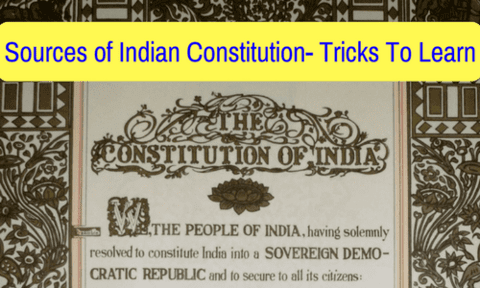
Sources of Indian Constitution- Tricks To Learn

Articles by Ebadul
Sources of Indian Constitution- Tricks To Learn
In this article, we learn how to remember sources of Indian Constitution easily by developing some tricks.
Introduction of the Topic is Preamble (US). The Constitution of following countries is the source of Indian Constitution.


Trick 1:

Freedom (Liberty, equality and Fraternity) – France
FranceRepublic and the ideals of Liberty, equality and Fraternity in the preamble.


Trick 2:

Judiciary and Judicial related terms are taken from US
USJudicial Review and Independence of Judiciary.


Trick 3:

Britain-Parliamentary-Law
BritainParliamentary Government, rule of Law, Law making Procedure.


Trick 4:

Vice-President in US and President in Ireland
USVice-President
IrelandPresident


Trick 5:

USSR-Duties were US Rights removed by Germany
USSRFundamental Duties
USFundamental Rights
GermanySuspension of Fundamental Rights during Emergency.


Trick 6:

Canada is centre of Jurisdiction
CanadaFederation with a Strong Centre, Residuary Powers with Centre, appointment of State Governors by the centre, advisory jurisdiction of the supreme court.


Trick 7:

  • Nomination of members of Rajyasabha – Ireland
  • Election of members of Rajyasabha – South Africa
IrelandNomination of members in the Rajyasabha
South AfricaElection to the Rajyasabha members


Trick 8:

  • Preamble – US
  • Preamble Language – Australia


Trick 9:

Bicameral cabinet with CAG citizenship
BritainBicameralism, Cabinet system, Office of the CAG, single citizenship.

FORM

// Data attributes data-tally-open="nWgJPR" data-tally-emoji-text="👋" data-tally-emoji-animation="heart-beat"...